Wat Arun: Visiting The Temple Of Dawn
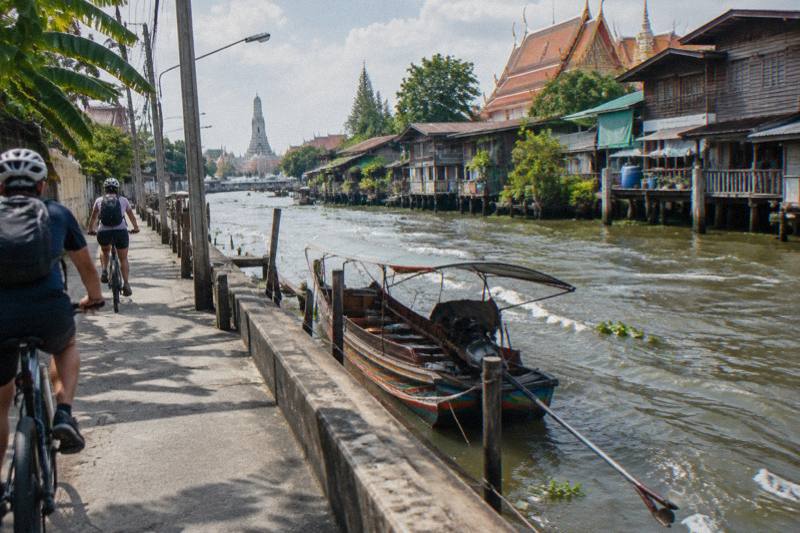
Wat Arun sits on the Thonburi bank of the Chao Phraya, and it is one of the landmarks that Bangkok bike rides genuinely pass rather than view from a coach window.
In Short
Wat Arun is the riverside pagoda on the Thonburi side of the Chao Phraya. Foreign visitors pay 200 baht to enter, and the temple is open roughly 8:00 AM to 6:00 PM, with last entry about 5:30 PM. The Temples and Canals ride, from $22.00 per person and 4.9 across 4,122 reviews, passes the river-crossing context, and several tours include the short ferry crossing.
Wat Arun, the Temple of Dawn, is the porcelain-studded pagoda that stands on the west bank of the Chao Phraya river in Thonburi. For cyclists it has a particular appeal: it belongs to the quieter, canal-cut side of the city that Bangkok bike rides actually travel through, and it is visible from the water and the opposite bank in a way that few city landmarks are. This guide covers what the temple is, which rides pass closest to it, what those rides cost, how the river crossing works, and the practical questions that come up around clothing, timing and common mistakes. Just across the river on the Bangkok side sits Wat Pho, and the guide to the Reclining Buddha temple covers how to reach it by bike or boat, the dress rules, and which guided rides pass the old town.
The river is Bangkok's oldest road, and it is still the most pleasant way to move between the old town and Thonburi. The Chao Phraya Express Boat operator's own site lists its lines and fares, and one caution belongs here: the confirmed fares, such as the Orange line's flat 19 baht, are weekday commuter services on long north-south runs, and the operator's page gives no fare for the central tourist piers or the short hop to Wat Arun. The small cross-river ferry from Tha Tien near Wat Pho costs about 3 to 5.5 baht one way, paid in cash on the day, so small notes are useful.
What Is Wat Arun And Why Do Cyclists Cross The River For It?
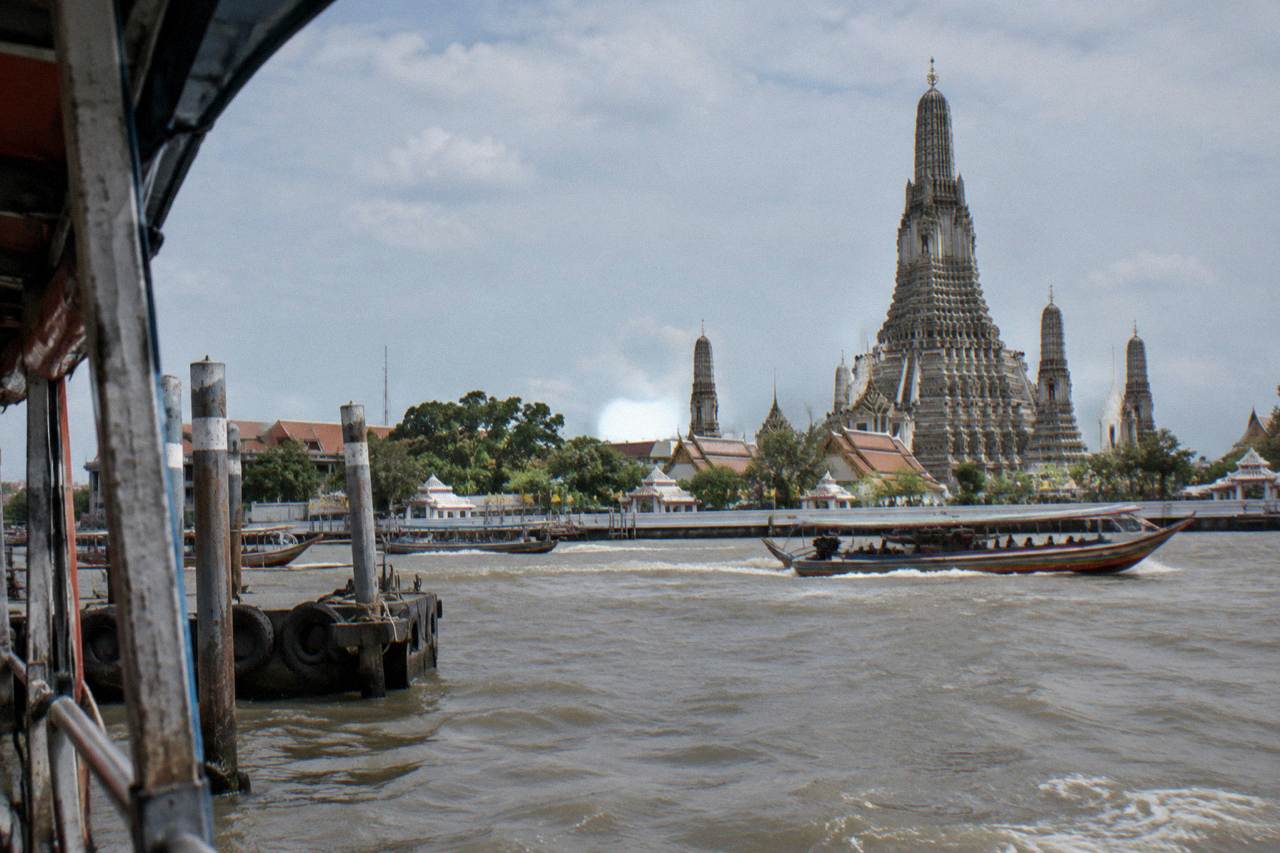
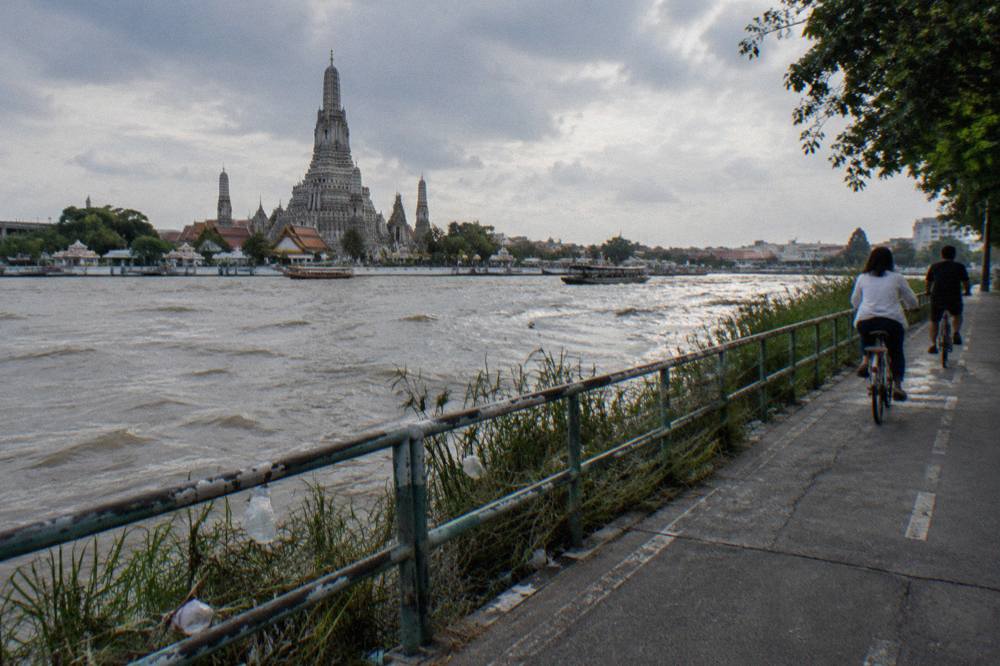
Wat Arun is a Buddhist temple on the Thonburi bank of the Chao Phraya, named after Aruna, the Indian god of the dawn, and best known for its central tower covered in pieces of broken porcelain. It faces the old city across the river, which means a visit almost always involves a crossing, and that crossing is exactly the kind of water move that several Bangkok bike tours build their routes around.
The temple's full name is Wat Arun Ratchawararam Ratchaworamahawihan, though almost nobody uses it. The main prang is the image that appears on Thai ten-baht coins, and the porcelain that clads it arrived as ballast in Chinese trading ships, a detail that gives the decoration its story: the fragments were cut and set into the stucco rather than made for the building. King Taksin is said to have reached the temple at dawn after the fall of Ayutthaya, which is the origin of the dawn association that stuck in the English name.
For a cyclist, the geography matters more than the history. Wat Arun stands on the west bank, in what was the separate city of Thonburi until the two were merged. The old town, the Grand Palace, Wat Pho and the flower market are all on the east bank. A bike tour that crosses the river by ferry moves between the two worlds, from the monumental east bank to the lane-and-canal grid of Thonburi, and the crossing itself is a feature of the ride rather than a delay. The Thonburi side of the river is where most of Bangkok's quiet cycling happens, and Wat Arun is its most recognizable landmark.
No entrance fee or opening hours for Wat Arun are confirmed in the verified sources used here, so treat any figure you see elsewhere with caution and check the temple's own channels or your tour operator before planning an independent visit. What is confirmed is that bikes and ferries are how the neighborhood is actually experienced, and that the short ferry crossing to the temple is included in several guided rides. The Bangkok canal bike tour routes exist largely because this part of the city rewards two wheels.
The table below sums up the two-bank geography a visitor is actually dealing with, landmark by landmark, since the river is the organizing fact of any Wat Arun day.
| Bank | Character | What stands there | How cyclists experience it |
|---|---|---|---|
| East bank (old city) | Monumental, busy | Grand Palace, Wat Pho, flower market, Yaowarat | Crossed by temple and market rides, usually the start side |
| West bank (Thonburi) | Lane-and-canal grid, village scale | Wat Arun, canal neighborhoods, Bang Krachao beyond | Where most quiet riding happens, reached by ferry |
| The river itself | Working waterway | Express boat lines, cross-river ferries | Included as a crossing in several guided rides |
Which Bike Rides Pass Closest To Wat Arun?
The ride that most directly covers this bank of the river is the Temples and Canals ride: 3 hours, from $22.00 per person, rated 4.9 across 4,122 reviews, meeting at 429 Krung Thon Buri Road on the Thonburi side, with the bike, a guide, bottled water and a group capped at 8 included, and stops at Talat Phlu, Wat Khun Chan, Wat Paknam Phasi Charoen, Wat Nak Prok and Wutthakat rather than Wat Arun itself. Its meeting point alone puts it on the temple side of the river.
The Thonburi meeting point of the Temples and Canals ride is the detail worth noticing: the ride starts on the temple side of the river, in the district where Wat Arun stands, rather than shuttling across from the tourist east bank. Its 4,122 reviews make it the most reviewed tour covered on this site, and its from-price of $22.00 is among the lowest for a guided ride anywhere in the city. The route runs through temple and canal territory, which is the experience most people picture when they think of cycling near Wat Arun.
Around it sit rides that frame the same river differently. The Canal Boat Combo with Lunch runs 3.5 hours from $45.00 per person, rated 4.9 across 1,592 reviews, meeting at Thanon Itsaraphap, and pairs the bike with a canal boat and a helmet and lunch included, group capped at 10. At the top of the price range, the 8-Hour Boat and Bike tour from $113.15 per person, rated 5.0 across 26 reviews, includes hotel pickup and lunch, and spends the better part of a day moving between boat and bicycle. Which one fits depends on how much of the river you want to consume: three hours of canal lanes, a half-day with lunch, or a full circuit of Bangkok by water and wheel.
Other rides touch the same neighborhoods without the temple as their headline. Several tours in this family include a short ferry crossing as a matter of course, because threading the Thonburi canals usually means touching the river at least once. If temples are the priority rather than a specific landmark, the temple rides compared on this site lay out the options by route character and price.
How Much Do Temple And Canal Bike Tours Cost?
Prices across the rides that cover the river-crossing territory run from $22.00 to $113.15 per person, from-price basis. The Temples and Canals ride is the cheapest of the temple-and-water family at $22.00, a cluster of half-day options sits between $39.86 and $56.73, and the full-day boat-and-bike experience tops the group at $113.15 with pickup and lunch included.
The table below pulls the from-prices for the rides that put you closest to Wat Arun's side of the river. All figures are per person, from the tour descriptions, and group-size caps, meals and crossings are noted so you can compare like with like.
| Ride | Duration | From price | Rating and reviews | Group cap | Included extras |
|---|---|---|---|---|---|
| Temples and Canals, 3 Hours | 3 hours | $22.00 | 4.9, 4,122 reviews | 8 | Bike, guide, bottled water |
| Canal Boat Combo, Lunch | 3.5 hours | $45.00 | 4.9, 1,592 reviews | 10 | Bike, helmet, guide, lunch, boat crossing |
| 8-Hour Boat and Bike, Pickup | 8 hours | $113.15 | 5.0, 26 reviews | 8 | Bike, guide, lunch, hotel pickup |
| Culture Ride, 3 Hours 30 Minutes | 3.5 hours | $42.62 | 4.5, 52 reviews | 9 | Bike, helmet, guide, snack, bottled water |
| Chinatown, Flower Market, Turtles | 4 hours | $39.86 | 4.9, 90 reviews | 8 | Bike, helmet, guide, snack, boat crossing |
What the from-price buys varies more than the spread suggests. The $22.00 Temples and Canals ride includes no meal, only bottled water. The $45.00 combo adds lunch, a helmet and the canal boat. The $113.15 full-day tour adds pickup and eight hours of guiding. In Bangkok, reading the inclusions line by line matters more than in most destinations, because the difference between a snack and a meal is real: a snack is not lunch, and several tours exclude food entirely.
The inclusions picture is easiest to compare side by side, since two rides at nearly the same price can differ by a full meal and a boat.
| Inclusion | Temples and Canals, 3 Hours | Canal Boat Combo, Lunch | 8-Hour Boat and Bike, Pickup |
|---|---|---|---|
| Bike | Included | Included | Included |
| Helmet | On request | Included | Not stated |
| Guide | Included | Included | Included |
| Meal | None stated | Lunch | Lunch |
| Drinks | Bottled water | Bottled water | Bottled water |
| Boat or ferry crossing | Included | Included | Not stated |
| Hotel pickup | No | No | Included |
| Free cancellation | Stated on the tour page | Stated on the tour page | Stated on the tour page |
Free cancellation is stated on most of these options, including the Temples and Canals ride, the Canal Boat Combo and the 8-Hour Boat and Bike tour, so plans can flex if the weather turns. A couple of rides in the wider family do not state a cancellation policy at all, and for those the booking page is the only source.
How Do You Get To Wat Arun By Boat?
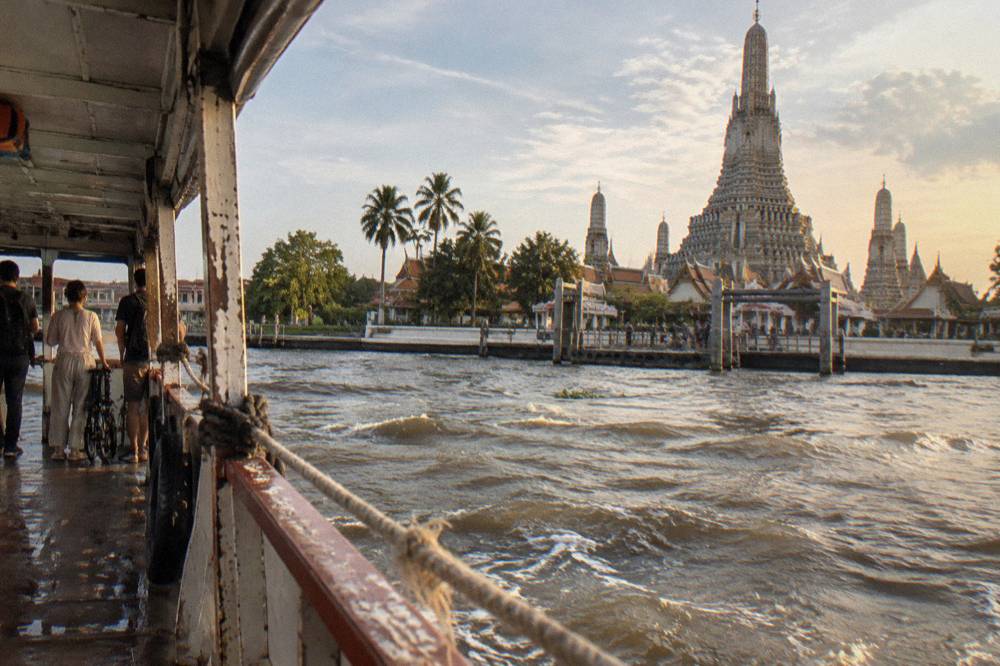
The classic approach to Wat Arun is by river: the express boat network runs along the Chao Phraya, and the official operator confirms commuter lines including the Orange flag at a flat 19 baht Monday to Friday, though these commuter lines are not the tourist-area boats and no fare to the temple pier itself is confirmed. From the east bank, a short cross-river ferry runs to the temple, and guided bike tours include their crossings.
The confirmed commuter fares are worth a small table of their own, if only to make the caution concrete: these are weekday lines, and none of them is the boat to the temple pier.
| Line | Route | Fare | Notes |
|---|---|---|---|
| Orange | Nonthaburi to Rajsingkorn | 19 baht flat | Monday to Friday commuter service |
| Yellow | Nonthaburi to Sathorn | 24 baht flat | Monday to Friday commuter service |
| Red | Nonthaburi to Sathorn | 33 baht flat | Air-conditioned; weekday commuter service |
For the crossing itself, the tours have already solved the problem. The Temples and Canals ride includes a boat crossing in its price, as do the Canal Boat Combo and the Culture Ride. This is the quiet advantage of a guided ride in a river city: the boat is part of the route, timed into the day, and you are not standing at a pier working out which flag is which. Cyclists making their own way can use the regular cross-river ferry, described in general terms only here, since fares and timetables for it are unconfirmed.
The east-bank side of the crossing is also where other landmarks stack up. The express boat stops at Tha Chang (N9) and Tha Tien (N8), and that Wat Pho is about 10 minutes on foot from Tha Tien. That makes a temple-and-river day easy to assemble: Wat Pho on foot, the ferry across, Wat Arun on the far side, and the flower market or the Grand Palace in reach of the same piers.
What Should You Wear When Cycling To A Thai Temple?
Dress for two things at once: heat on the bike and modesty at the temple. Thai temple etiquette expects covered shoulders and knees, and cycling kit does not automatically qualify. One verified official example shows how strict this can be: the Grand Palace's published banned list includes short pants, tight pants and, notably, bike pants, so riding clothes at a major royal site are a real problem.
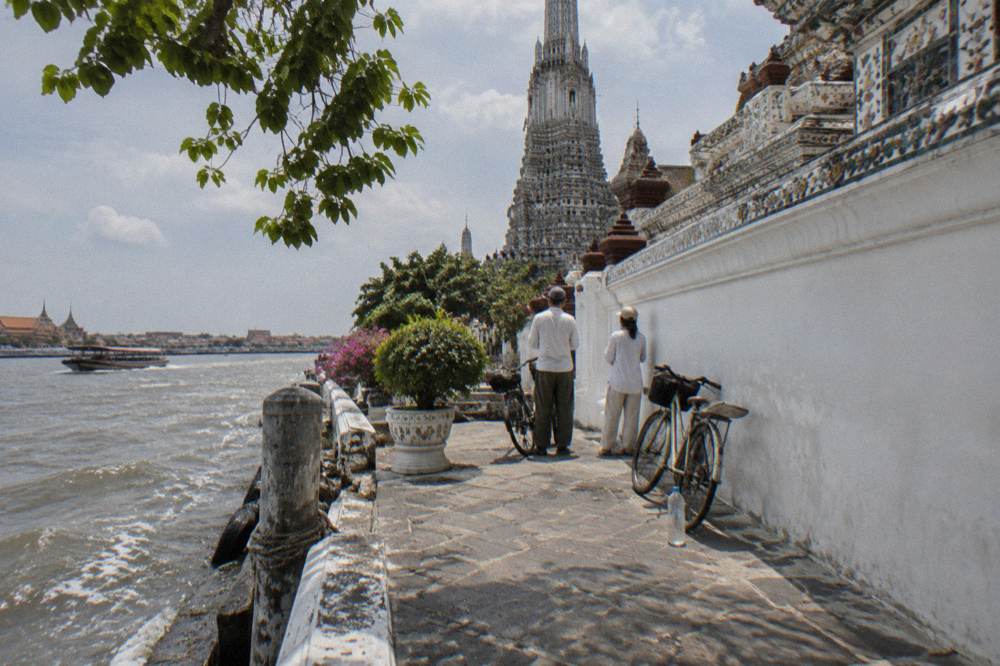
The practical solution is a lightweight layering approach. Ride in whatever keeps you cool, but carry a long, light pair of trousers or a wrap and a top with sleeves, and change or pull them on before entering temple grounds. Fabrics that dry fast do double duty, since a canal-side ride in the wet months can leave you damp and a temple visit still needs the covered version of you. Footwear that slips on and off easily earns its place too, as temple buildings ask for shoes off at the door.
The Grand Palace example is worth taking seriously even though Wat Arun's own rules are not confirmed in the sources used here. The official visitor page bans sleeveless shirts, vests, short tops, see-through tops, short pants, torn pants, tight pants, bike pants, mini skirts, pants skirts and sleeping suits, and it also bans drones. If your day combines a temple ride with a palace stop, which many old-town itineraries do, the clothing question is no longer optional. The dedicated clothing advice for Bangkok rides works through the full kit list.
Helmets are a separate matter. The Temples and Canals ride lists a helmet on request rather than as a guaranteed inclusion, while the Canal Boat Combo and the Culture Ride include one outright. Helmets aside, the booking page for each ride is the place to confirm the rest of the gear, from child seats to bike lights, before you set off.
When Is The Best Time Of Year To Ride To Wat Arun?
Thailand splits into roughly six rainy months, three cooler dry months and three hot months, with national average temperatures spanning 18 to 38 °C. The driest stretch is roughly December to February and the hottest roughly March to May, while September and October are the wettest months, so the cooler dry window is the most comfortable time for a river-and-temple ride and the wettest two months are the ones to build flexibility around.
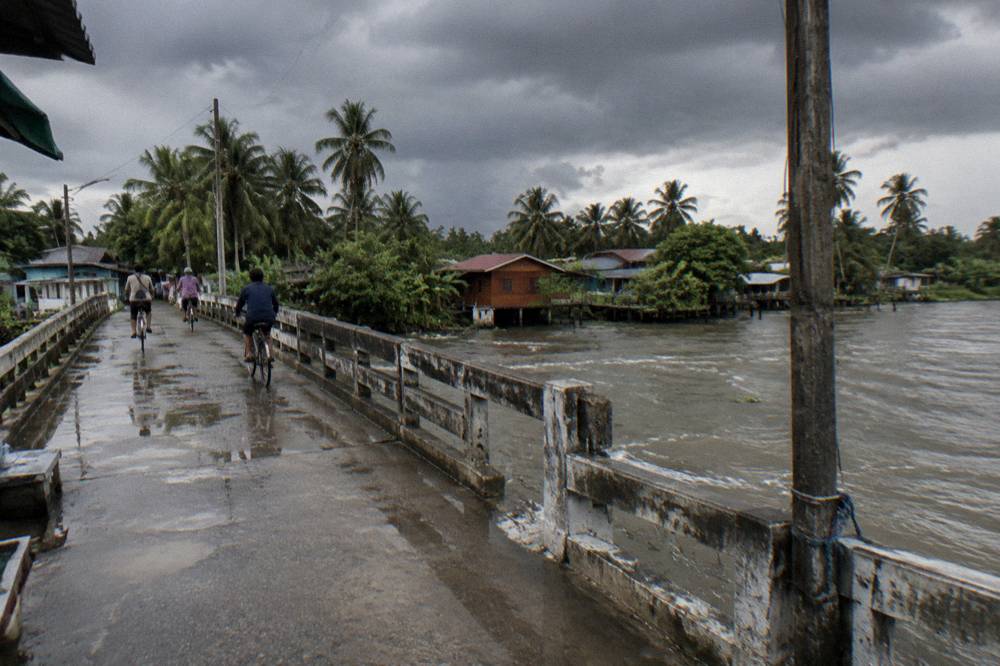
The Tourism Authority of Thailand's weather guidance gives the seasonal structure, and the honest reading is that Bangkok is rideable year-round with adjustments. In the hot stretch, morning departures matter: a three-hour ride that starts early finishes before the worst of the heat. In the wet months, rain tends to arrive in intense spells rather than all-day drizzle, and the free-cancellation terms on most of these tours exist precisely for the days when a downpour wins. The rainy season riding guide covers the practical side, from what a tour does when the sky opens to how canal paths behave after heavy rain.
Day length and light matter to photographers, though no sunrise or sunset times are confirmed here and none should be quoted. The temple's name makes dawn the romantic target, and the east-bank view across the water is the classic composition. What a bike tour adds is a set of angles most visitors never get: the Thonburi lanes behind the temple, the canal-side approaches, and the river seen from a ferry deck rather than a hotel window.
What Mistakes Trip Up Visitors At Wat Arun?
The recurring mistakes are arriving in cycling clothes that temples will not accept, assuming a fixed entrance fee or opening hours that are not confirmed, mistaking commuter boat fares for tourist-pier fares, planning a rigid schedule in the wet months, and underestimating how different the two river banks are. Each is avoidable with one piece of planning.
The clothing mistake is the most common, and it is baked into an official rule elsewhere in the city: bike pants are on a banned list at the Grand Palace, and shorts or sleeveless tops are a poor bet at any Thai temple regardless. Carry the modest layer. The fee mistake runs the other way: this guide prints no Wat Arun fee or hours because none are verified, and any confident number seen on a forum or a third-party page deserves a check against the temple's own channels before you build a day around it.
The boat mistake is subtler. Confirmed fares of 19 to 33 baht belong to weekday commuter lines on long runs, and presenting them as the price of the hop to the temple pier would be wrong. For currency generally, the Bank of Thailand's published exchange rates put the baht at about 33 to 34 per US dollar, useful when a tour price is in dollars and pier snacks are not. The rigidity mistake is simply calendar-awareness: September and October are the wettest months, roughly, and a plan with cancellation flexibility beats a plan without one.
The last mistake is geographical. Visitors who never cross the river see only the east-bank skyline and miss the reason cyclists come: Thonburi's lanes, canals and village-scale neighborhoods, which is where a bike stops being transport and becomes the point. A ride that starts on the Thonburi side, such as the Temples and Canals tour, makes that argument for you.
The wider guide to cycling in Bangkok covers traffic behavior, road conventions and the left-side driving rule, all of which apply on the approaches to the river.
Which Ride Should You Book For A Wat Arun-Centered Day?
For most visitors the answer is the Temples and Canals ride: it starts on the Thonburi side at 429 Krung Thon Buri Road, costs from $22.00 per person, runs 3 hours with a group capped at 8, and its 4,122 reviews make it the most reviewed tour of its kind in the city. Free cancellation is available for this tour.
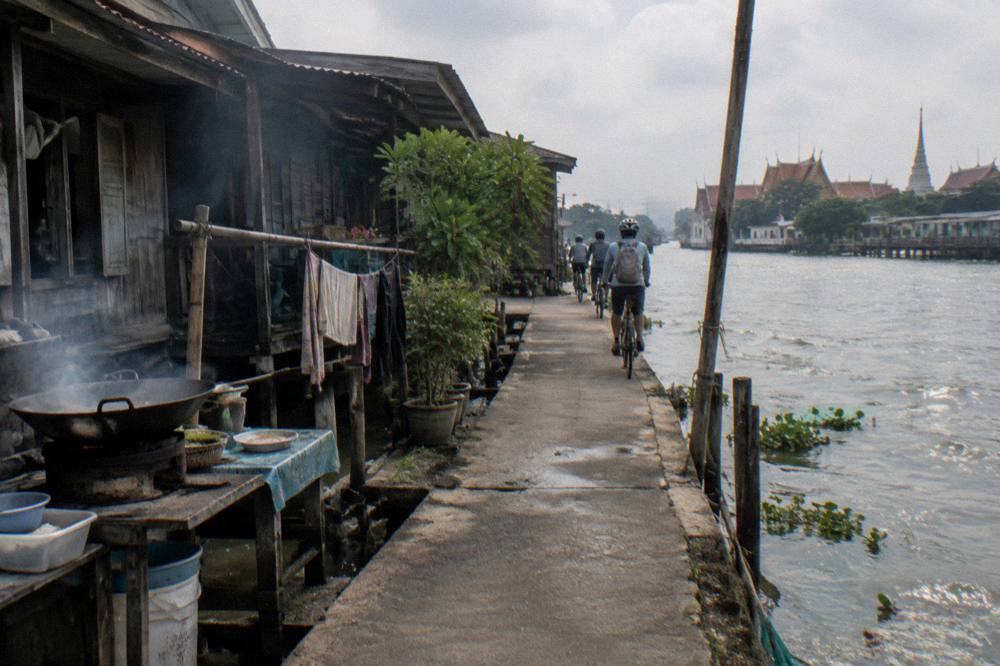
The reasoning is simple. A three-hour ride fits a Bangkok day that also holds the Grand Palace or the flower market, and its meeting point puts you on the right bank from the first minute. The included boat crossing means the river is part of the route, not an obstacle. Bottled water comes with the price, and free cancellation is stated, which matters most in the wet months. The tour provides a helmet on request rather than a guaranteed one, and does not include a meal, so plan breakfast accordingly.
The upgrade path is real rather than cosmetic. The Canal Boat Combo adds lunch, a helmet and a canal boat to a similar half-day shape, and its 4.9 rating across 1,592 reviews shows the format works for a lot of travelers. The 8-Hour Boat and Bike, rated 5.0 across 26 reviews, is the choice when a single day has to contain as much of Bangkok's water-and-wheel character as possible, and its hotel pickup removes the logistics question entirely. Whichever you choose, Bangkok Bike Tours exists to make that comparison concrete, with prices and inclusions laid out ride by ride.
Three rides, three shapes of day: the table below is the short version of everything above.
| If you want... | Book | Why |
|---|---|---|
| The cheapest, most reviewed temple-side ride | Temples and Canals, 3 Hours | From $22.00, 4,122 reviews, starts on the Thonburi side |
| A half-day with lunch and a canal boat | Canal Boat Combo, Lunch | From $45.00, helmet and lunch included, boat in the route |
| A full day with hotel pickup | 8-Hour Boat and Bike, Pickup | From $113.15, 8 hours, lunch and pickup included |
Common Questions About Wat Arun
What Is Wat Arun?
Wat Arun is a Buddhist temple on the Thonburi bank of the Chao Phraya river in Bangkok, named after the Indian god of the dawn. Its central tower is decorated with pieces of broken porcelain that arrived in Chinese trading ships as ballast, and it is one of the city's most recognized landmarks.
How Much Does It Cost To Enter Wat Arun?
No entrance fee for Wat Arun is confirmed in the verified sources used here, so none is printed. Check the temple's own channels before an independent visit. Guided bike tours that include the river-crossing context price the ride, not the temple: the Temples and Canals tour starts from $22.00 per person.
Can You Reach Wat Arun On A Bike Tour?
Yes. The Temples and Canals ride starts on the Thonburi side at 429 Krung Thon Buri Road, in the district where the temple stands, and includes a boat crossing in its price. Several other rides, including the Canal Boat Combo with Lunch and the Culture Ride, also include a boat or ferry crossing on their routes.
What Should You Wear To Cycle To Wat Arun?
Covered shoulders and knees are the temple standard, and cycling kit does not automatically qualify. Carry lightweight long trousers and a sleeved top to change into. The Grand Palace's official banned list, a useful benchmark, includes short pants, tight pants and bike pants, so riding clothes are a genuine risk at major royal sites.
How Do You Cross The River To Wat Arun?
A short cross-river ferry connects the east bank with the temple, and bike tours include their crossings as part of the route. For the express boat network, the operator's confirmed fares of 19 to 33 baht apply to weekday commuter lines, not the tourist piers; no tourist-area fare is confirmed, so pay on the day.
When Is The Best Time To Visit Wat Arun?
Roughly December to February is the driest, most comfortable window, with national average temperatures spanning 18 to 38 °C across the year. The hottest stretch is roughly March to May and the wettest months are roughly September and October, when free cancellation on a tour booking is worth having.